
Henry's "T"s ... changed the world ...
13,000,000 built - 1912 -1925

1910 Ford "T" Racer (reproduction) was key to Ford's success. 1901-1912 they broke records proving their durability. Famed Barney Oldfield piloted for Mr. Ford

Exploded Model "T" at Henry Ford Museum.
A moving assembly line, and interchangeable parts achieved low cost. Its 1,481 parts could be assembled by a teenager.
Other quality cars were available, but prices were higher. "T"s were priced from $260 to $850.

1921 Touring Model. Neighbor John Zimmer on one of the "T"s he and his father cared for.
Model "T" engine. Cast iron Valve-in-Block, 177 cid, 3.98:1 Compression Ratio, spash lubricated bearings, magneto ignition, water cooled. 20 horse power.
The Model "A" engine was of similar design but had (double), 40 horse power. Electric start was added . Compression ratio increased to 4.22:1.
Engines were widely used in farm machinery, boats, etc; shown here as aircraft engine, reverse orientation, higher HP, improved engine oiling ... and considerable tinkering and know-how required.

The "Tin Lizzie" ... Loved, then not so much ...

The Model "T" Over its 13 years, the "T" was built in over 12 body styles, Coupes, Roadsters, Touring models, and trucks. The auto aftermarket was created with parts to add power, comfort, and style. In the 20's it became outdated and sales collapsed. Essex, Chevrolet, Dodge and others produced better cars, contrary to Mr. Ford's insistence.
1927, the new Ford "A" ... was an instant success ...
Henry resisted replacing the Tin Lizzie, yet took full credit for the A's success

Even today, the Model A is comparatively modern. Mfrd 1927-1931, Speeds to 65 mph, improved brakes, electric start, manageable controls, was a huge step forward, and a key ingredient for the exploding hot rod culture.


Commercial Vehicles were quickly added to T's and A's model offerings. Serial numbers 'AA' indicated truck chassis.
Model A Coupe: double horse power, easy shifts, electric start, good brakes vs. the "Tin Lizzie".
"1932" Ford Flathead V8 arrives
Ford V8 Flatheads, 1932-1953. The Go-to Hot Rod motor for two plus decades


Early Flathead. 220 cubic inches, 5.6:1 Compression ratio. Continuous improvements of the flathead over its 21 year production span ... 1932-1953

Henry and son Edsel show the V8 Flathead engine.
The V-12 (12 cylinders) Flathead. Lighter aluminum cylinder heads increased compression ratio for added horsepower.
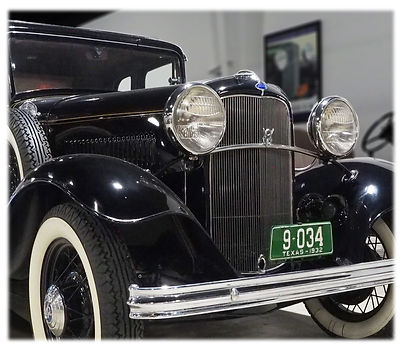
1932 Business Coupe sporting the new 'V8" logo.
Speed Records fell ... tricks made more power ...
Flatheads could produce 100 mph ... then much more

Speed records. The availability of low cost parts and intense interest by the new motoring crowd fueled the hot rod era, creating the vast, unique American car culture.
Replica of the Karlorr Speed Shop roadster. The original managed 122.87 mph with its 239 cu. in. flathead with Harmon camshaft, and Eddie Myer cylinder heads.
The Flathead's power enabled greater speed. 100 mph plus could be achieved easily. Speed shops offered performance parts. This Model A Roadster was the perfect platform for speed.

Left, a Coupe, with a monster Big Block 400 CI Chevy motor. This builder wanted big power ... for show,, street or drag strip?
Manifolds for the flathead. 2 and 3 carburetor set-ups, 4 barrels, what have you were widely available.

Depression Strikes ...
The Great Depression dramatically reduced auto production. Men went off to war. The fortunes of auto companies changed dramatically
The Flathead powered Fords, new in 1932, were introduced as the Model 18, later just named Ford V8s. A four cylinder was offered as the Model B.
1935-37 Fords were similar. 1935 was big year with 820,000 sold, beat Chevy.
Only handfull of 42 Fords were built in 1942, the government stopped production in early February.
Post war 46-47-48 Fords were similar.
1934 Ford Cost $575.

Post war Art Deco styling made cars appealing ... this 1936 Convertible was a good buy at $1629, but buyers were scarce. The Great Depression had taken hold. No job, no money, no credit.


The Depression and War years saw
the growth of theaters and dance halls that provided low cost entertainment.
War Era 1937-1940 - improved cars but few buyers
U.S. enters War in December 1941 ... large numbers of men went off to war, and government spending hastened the Depression's ending.


1940 Ford Deluxe Coupe
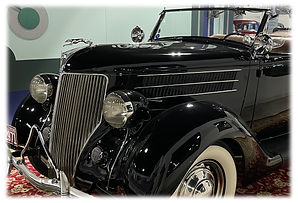
1936 Convertible
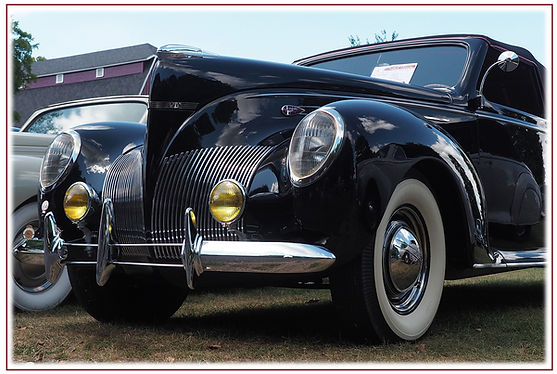
1939 Lincoln Zephyr convertible. These models featured the 12 cylinder flathead.